
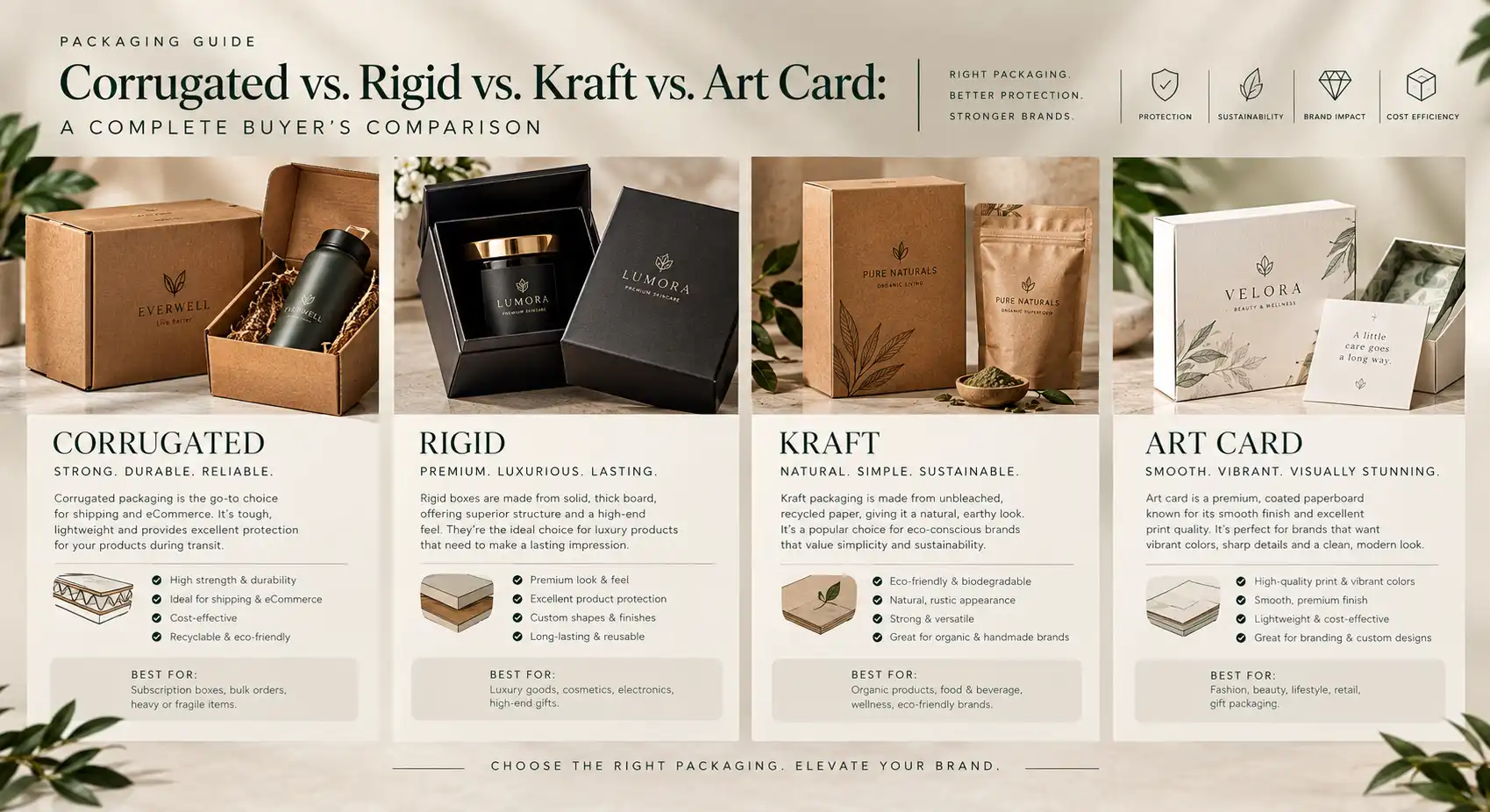
Corrugated vs. Rigid vs. Kraft vs. Art Card: A Complete Buyer’s Comparison
If you’ve started researching custom packaging, you’ve probably run into four terms that all sound like reasonable options for your product: corrugated, rigid, kraft, and art card. They’re not interchangeable, and picking the wrong one usually shows up later as a cost problem, a durability problem, or a brand-perception problem. This guide compares all four directly, so you can narrow down to the right one before you request a quote.
The Short Version
If you just need the fastest possible answer: corrugated is for shipping and e-commerce, rigid is for premium and gift positioning, kraft is for natural or eco-positioned retail products, and art card is the versatile middle ground for retail-shelf packaging that needs strong print detail without rigid-box cost. The rest of this guide explains why, and where the exceptions are.
Corrugated: Built for Transit, Not Display
Corrugated boxes are made from fluted board sandwiched between liner sheets, and that fluted structure is what gives corrugated its defining strength: it absorbs impact well, which is exactly what you want for a box that’s going to be handled by multiple people and vehicles between your warehouse and your customer’s door.
- Best for: E-commerce shipping, subscription boxes, food and beverage shipments, anything that travels through a parcel carrier.
- Cost tier: Lowest of the four materials, generally.
- Trade-off: Print detail is good but not as sharp as coated stocks, and it doesn’t have the “premium in-hand feel” that rigid or art card packaging can deliver — it’s not designed to.
Rigid: Built for the Unboxing Moment
Rigid boxes use a thick, non-folding paperboard wrapped in printed paper or specialty material, which is why they hold their shape and feel substantial in the hand — there’s no folding-carton “give” to a rigid box the way there is with kraft or art card.
- Best for: Cosmetics, jewelry, electronics accessories, gift sets — anything where the packaging itself is part of the perceived value of the product.
- Cost tier: Highest of the four materials, due to tooling, wrap application, and assembly.
- Trade-off: Heavier and bulkier to ship than the other three, and the added cost only pays off if your price point and brand positioning can support it.
Kraft: Built for a Natural, Considered Aesthetic
Kraft boxes are paperboard with a natural, unbleached brown finish (though white kraft options exist too), and they’re the default choice for brands leaning into a natural, handmade, or sustainability-forward identity.
- Best for: Soap, candles, bakery goods, small-batch retail products, brands prioritizing an eco-forward visual identity.
- Cost tier: Low to moderate, similar to or slightly above corrugated depending on finish.
- Trade-off: The brown base changes how printed color reads — bright whites and pastels look different on kraft than on white stock, which matters if your brand relies on precise color matching.
Art Card: The Versatile Middle Ground
Art card boxes are coated paperboard — smooth, printable, and capable of sharp, detailed graphics — without the thickness or cost of rigid board.
- Best for: Cosmetics (especially lower-to-mid price point), supplements, small electronics, retail products that need strong shelf presence without rigid-box cost.
- Cost tier: Moderate — more than kraft or corrugated, less than rigid.
- Trade-off: Doesn’t have the same structural weight or “premium heft” as rigid — a real consideration if your positioning depends on that physical sensation.
Side-by-Side Comparison
| Material | Best For | Price Tier | Structural Feel |
|---|---|---|---|
| Corrugated | Shipping, e-commerce, food & beverage | $ | Sturdy, functional |
| Kraft | Natural/eco retail, bakery, candles, soap | $ | Light, foldable |
| Art Card | Retail shelf presence, cosmetics, supplements | $$ | Smooth, crisp print |
| Rigid | Premium/gift positioning, jewelry, electronics | $$$ | Substantial, rigid |
A Practical Way to Decide
Ask yourself two questions: How is the product primarily reaching the customer — shipped directly, or bought off a retail shelf? And what does the price point need to communicate — functional and efficient, or premium and considered? A $15 product shipped direct-to-consumer rarely needs rigid packaging. A $150 product sold as a gift rarely belongs in a plain corrugated mailer. Most packaging mismatches come from skipping this step and picking a material based on what looked good in a reference photo rather than what the product and price point actually call for.
Frequently Asked Questions
Can I mix materials — for example, a kraft box shipped inside a corrugated mailer?
Yes, and it’s common. Many brands use a more premium or branded material (kraft, art card, or rigid) for the product-facing packaging, then ship that inside a plain or lightly branded corrugated outer box for transit protection.
Which material is easiest to reorder in different quantities later?
All four materials support reordering at any quantity — there’s no minimum order quantity on any of them. Rigid boxes generally see a bigger per-unit cost drop at higher quantities due to tooling costs being spread across more units, so if you’re planning to scale, factor that into your first-order quantity decision.
Is one of these four materials more sustainable than the others?
Each has different sourcing and recyclability characteristics, and specifics can vary by mill and material run. If certification or recycled-content documentation matters for your business, ask your account contact for current specifications on the exact material you’re considering.
Not sure which material fits your product?
Get a free quote and tell us your product type, price point, and how it reaches customers — we’ll recommend a material before you commit to anything.
