
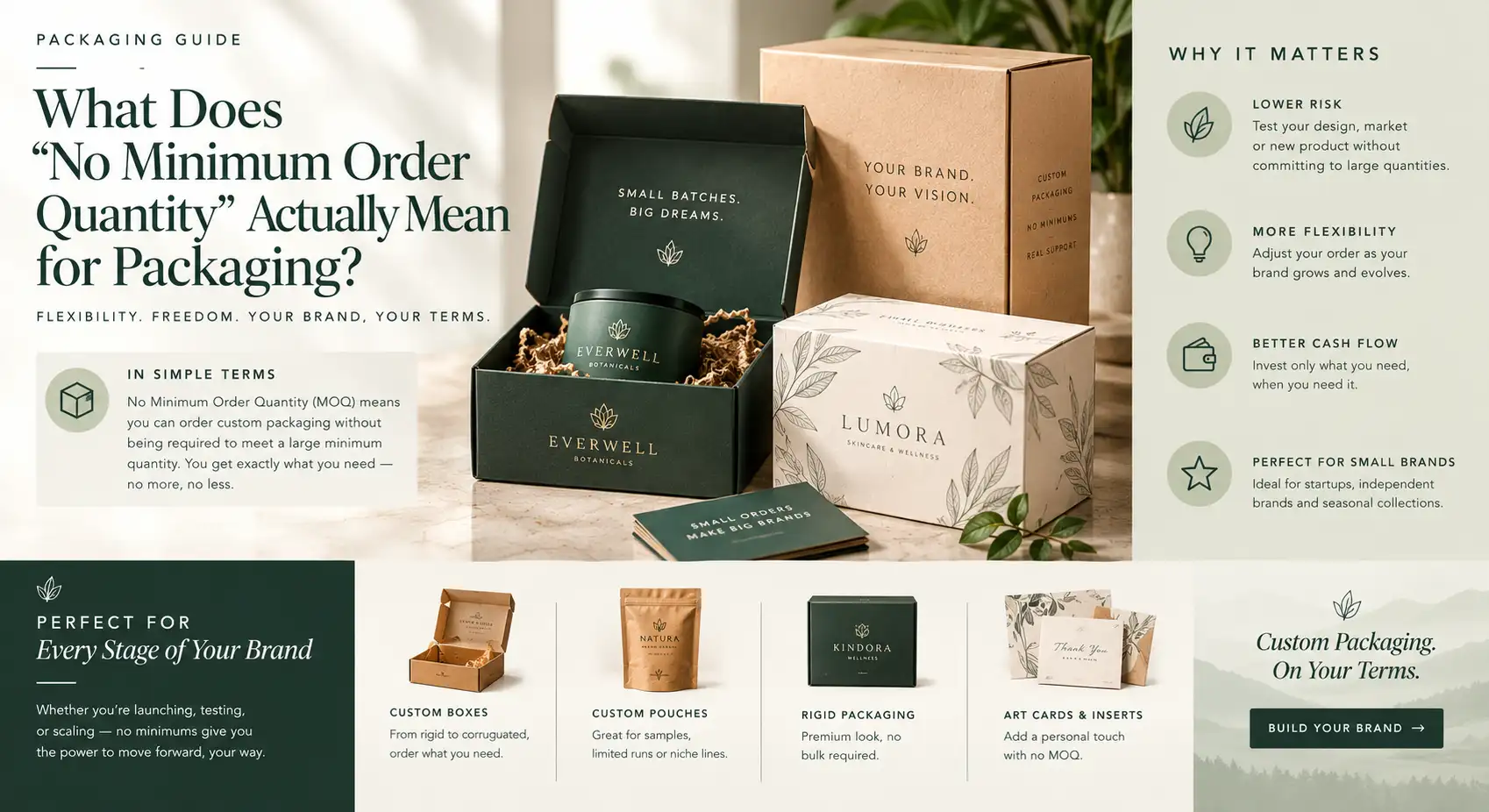
What Does “No Minimum Order Quantity” Actually Mean for Packaging?
“No minimum order quantity” is one of the most common phrases you’ll see across packaging suppliers’ websites, and it’s also one of the most vaguely used — some suppliers mean it literally (order 25 units if that’s what you need), while others mean “no minimum, but pricing under 500 units isn’t really practical.” This guide explains what the phrase should mean, what to watch for, and how to use it to your advantage as a smaller or newer brand.
Why Minimums Exist in the First Place
Packaging production has real fixed costs that don’t scale down with order size — plate setup, machine calibration, and material minimums from paper mills all cost roughly the same whether you’re printing 100 boxes or 10,000. Traditionally, manufacturers set order minimums (often in the thousands of units) so those fixed costs don’t make small orders unprofitable to produce. “No minimum order” suppliers have generally restructured their pricing or production process to absorb that math differently, which is why per-unit cost at low quantities is usually higher than at scale — the fixed costs are still there, they’re just spread across fewer units.
What “No Minimum” Should Actually Mean for You
At a supplier that genuinely means it, no minimum order quantity means:
- You can order a quantity that matches your actual current need — a 50-unit test run for a new product, not a 1,000-unit commitment you’re not ready for.
- Your per-unit price will be higher at low quantities than it would be at scale, and a transparent supplier will tell you that upfront rather than hiding it.
- You get the same design support, proofing process, and material quality regardless of order size — a small order shouldn’t mean a lower-priority or lower-quality process.
What to Watch For
Not every “no minimum” claim holds up the same way in practice. Before assuming it applies cleanly to your specific project, ask directly:
- Does the no-minimum policy apply to every material, or only some?
Some suppliers apply it broadly; others still require a higher minimum on more complex structures (like rigid boxes) due to tooling costs, even if their marketing says “no minimum” generally. - Is there a meaningful price cliff at a certain quantity?
Ask for pricing at your target quantity and at one or two higher quantities, so you can see whether there’s a large price jump that makes a slightly bigger first order the smarter move. - Does a smaller order get the same proofing and quality process as a larger one?
This is worth asking directly rather than assuming — it’s a reasonable, fair question, and a good supplier will answer it plainly.
Why This Matters More for Newer Brands
If you’re launching a new product or testing a new market, committing to a large minimum order before you know how the product will actually sell is a real financial risk — unsold inventory ties up cash and storage space regardless of how good the packaging looks. A genuine no-minimum policy lets you validate demand with a smaller run, then scale your packaging order alongside your actual sales, rather than betting on a large order upfront.
Frequently Asked Questions
If there’s no minimum, why would I ever order more than I need right now?
Per-unit pricing typically improves as quantity increases, so if you’re confident in near-term demand, ordering a moderately larger quantity can lower your effective cost per unit. The right call depends on your confidence in near-term sales and your available storage and cash flow — there’s no universally correct answer, which is exactly why the option to start small matters.
Does a small first order affect the quality or attention my order gets?
It shouldn’t, at a supplier that means what “no minimum” implies. Every order — small or large — should go through the same proofing and production quality process. If you’re evaluating a new supplier, this is a fair and reasonable question to ask directly before you order.
Can I start small and reorder at a higher quantity later without redoing everything?
Yes, typically — your original artwork, dieline, and material specifications should be saved and reusable for a reorder, so scaling up later doesn’t mean starting the design and proofing process over from scratch.
