
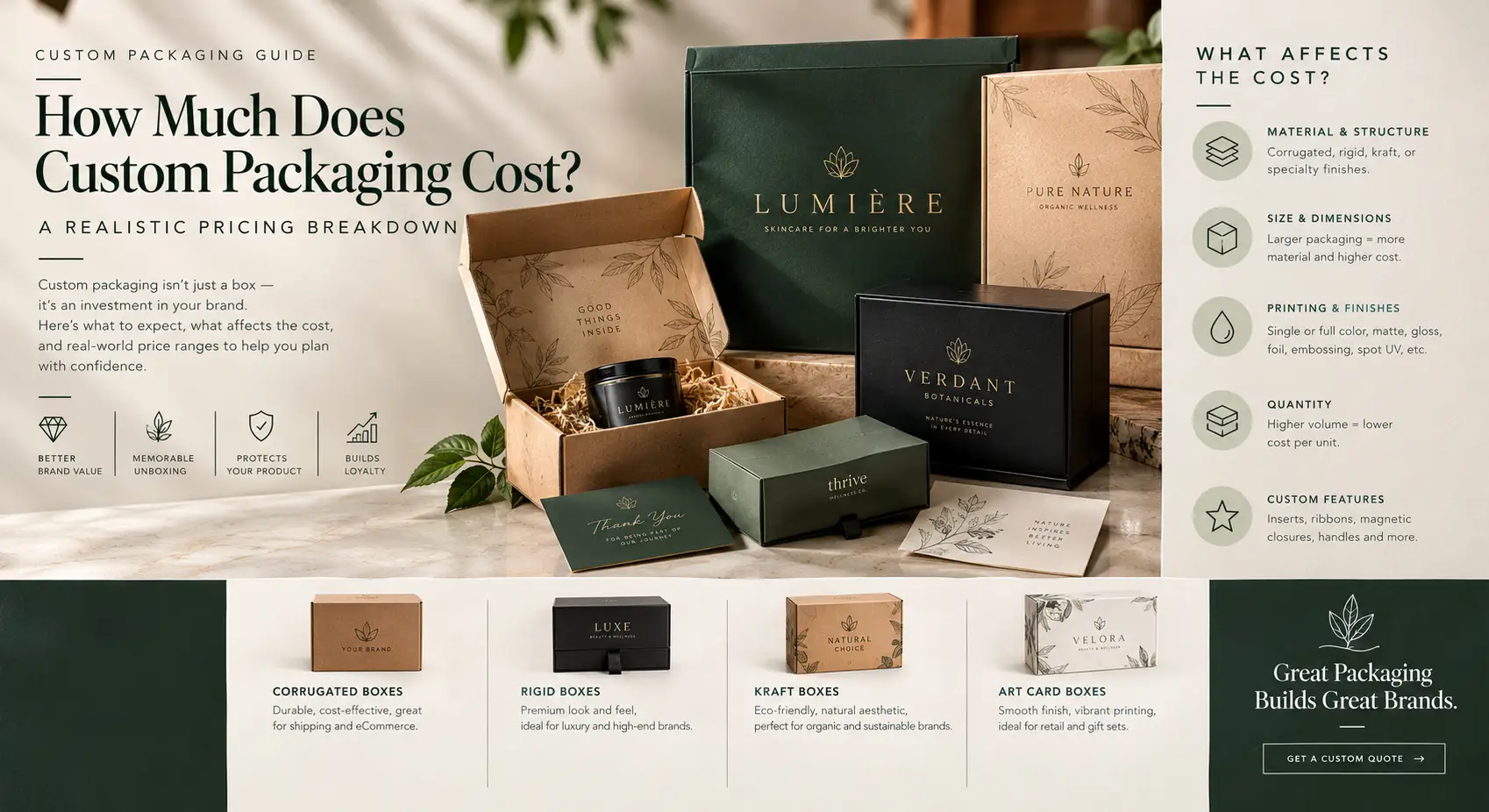
How Much Does Custom Packaging Cost? A Realistic Pricing Breakdown
“How much does custom packaging cost” is one of the most common questions we get, and it’s also one of the hardest to answer with a single number — because the honest answer is “it depends,” and vague as that sounds, it’s genuinely true. This guide breaks down exactly what drives packaging cost up or down, so you can understand your own quote once you get one, and so you know what levers you actually control before you request one.
Why There’s No Universal Price List
Custom packaging pricing isn’t like buying a standard product off a shelf — every quote reflects a specific combination of material, size, print complexity, finish, and quantity, and changing any one of those changes the number. Two boxes that look similar in a product photo can have meaningfully different costs if one uses a metallic foil finish and the other doesn’t, or if one is ordered at 500 units and the other at 5,000. Below are the factors that actually move the number, in roughly the order of impact.
1. Material Choice
This is usually the single biggest cost driver. As a general rule, corrugated and kraft sit at the lower end of the cost spectrum, art card sits in the middle, and rigid boxes sit at the top — largely due to the tooling, board thickness, and assembly labor rigid packaging requires. If cost is your primary constraint, material is the first place to look.
2. Order Quantity
Packaging pricing has real economies of scale — plates, tooling, and setup costs get spread across more units as your order size increases, which is why per-unit cost typically drops meaningfully between a 500-unit order and a 5,000-unit order of the same box. This doesn’t mean small orders are a bad idea — there’s no minimum order quantity, so testing at a smaller quantity before committing to a larger production run is a completely valid strategy — but it does mean your per-unit cost will usually improve as you scale.
3. Box Size and Structural Complexity
A simple, single-piece folding carton costs less to produce than a multi-piece structure with internal dividers, a separate insert, or a complex die-line (the pattern the box is cut and scored from). If your product doesn’t structurally require a complex build, a simpler structure is a legitimate way to control cost without compromising protection.
4. Print Complexity and Color Count
Full-color, photo-realistic printing costs more than a design using one or two spot colors. This doesn’t mean simple designs look cheap — some of the most effective packaging designs use a limited color palette deliberately — but if your design has flexibility, reducing color complexity is a real lever for cost control.
5. Finishes
Foil stamping, embossing, spot UV, soft-touch lamination, and similar finishes each add cost on top of base printing. These finishes are often worth it for brand impact, especially on rigid or art card packaging where the finish is doing real perceptual work — but they should be a deliberate choice, not something added by default without weighing the cost impact.
6. Inserts and Add-Ons
Foam inserts, tissue paper, printed inserts, and hang tags are usually quoted separately from the box itself. These add real cost, but they also often deliver disproportionate brand impact for the price, especially for gift-positioned products — the “reveal” moment inside the box is frequently what gets photographed and shared.
What This Means for Your First Quote
If you’re requesting your first quote and want to control cost without guessing at what to cut, the most efficient approach is to tell your packaging supplier your target price point up front, rather than specifying every detail and hoping the total comes in under budget. A good supplier can tell you which levers (material, finish, complexity) will get you closest to your target without you having to reverse-engineer it yourself.
Frequently Asked Questions
What’s the minimum order needed to get reasonable per-unit pricing?
There’s no fixed threshold — per-unit cost improves gradually as quantity increases, rather than dropping sharply at one specific number. Ask for pricing at two or three different quantities on your quote request so you can see the actual curve for your specific box.
Are there hidden fees I should ask about upfront?
Reputable suppliers should itemize plate/setup costs, material, printing, finishing, and shipping separately in a quote rather than bundling everything into one opaque number. If a quote you receive (from any supplier) doesn’t break costs down this way, ask for an itemized version before comparing it to other quotes.
Is it cheaper to order more than I need right now to get a better price?
Only if you’re confident you’ll use the excess inventory within a reasonable timeframe — packaging that sits unused isn’t actually saving you money, it’s tying up cash. A better approach is usually to order the quantity you’ll realistically use in the next few months and revisit pricing at your next order as your volume grows.
Want an exact number instead of a range?
Get a free quote — tell us your product, target quantity, and price point, and we’ll send back an itemized quote within 24 hours.
